


Table of Contents
- Where to Buy Original Abstract Art Online
- How to Verify Original Artwork Online
- Original Abstract Paintings for Sale: What to Look For
- Online Art Marketplaces for Original Paintings: Finding Your Match
- How to Choose Abstract Art for Your Home
- Direct Artist Collections: Why Buy Straight from the Creator
- Frequently Asked Questions
Last Updated: October 5, 2026
Where to Buy Original Abstract Art Online
Finding original abstract art that speaks to your style transforms a space, but shopping online raises real questions: Is the piece truly original? What's the total cost with shipping? Which marketplace fits what you want?
At Drunk Girl Art, we know buying art online requires confidence, you're deciding from images and descriptions, not standing in front of a canvas. This guide helps you navigate best sites for original abstract art.
What Makes a Marketplace Worth Your Attention
Not all art platforms are equal. Some focus on prints and reproductions, others curate emerging artists directly, and some leave verification to chance. The best marketplaces vet their artists, provide clear provenance, offer buyer protection, and are transparent about pricing, including shipping costs upfront. When evaluating where to buy, ask: Does the platform tell me who created the work? Can I see the artist's background and process? What happens if the piece arrives damaged? Clear answers separate trustworthy marketplaces from the rest.
How to Verify Original Artwork Online
Most guides say "look for a certificate of authenticity" and stop there. That doesn't answer the question that matters when you're staring at a listing: is this a one-of-a-kind original, or a print dressed up to look like one? Here's a practical verification process you can run on any listing in about ten minutes.
Step 1: Classify what you're actually looking at
Before you evaluate quality, confirm the category. Online art listings fall into four buckets:
- Original painting, a single, hand-made work. The artist painted it once; there is no second copy. Highest price, highest scarcity.
- Hand-embellished print, a reproduction that the artist has painted over or added to by hand. Still a print underneath, but each one is slightly unique.
- Limited-edition print, a reproduction produced in a fixed, numbered run (for example, "12 of 50"). The image is identical across the run; the value comes from the edition size and the artist's signature.
- Open-edition print, an unlimited reproduction. No scarcity, lowest price.
A listing that says "original" without specifying which of these four it is has told you nothing useful. The most clarifying question to ask a seller: "Is this a one-of-a-kind hand-painted work, or a reproduction?" A straight answer takes one sentence; a vague one is itself information.
Step 2: Read the physical description for tells
Original paintings and prints leave different fingerprints in a listing. Look for:
- Dimensions and surface. An original usually lists canvas or panel size and whether it is stretched, unstretched, or mounted. A print often lists "image size" versus "paper size."
- Medium. "Acrylic on canvas," "oil on linen," and "mixed media on birch panel" describe originals. "Giclée," "archival pigment print," and "fine art print" describe reproductions. Giclée is a printing process, not a painting method.
- Edition language. "1/1" means a single original. "AP" means artist's proof. A fraction like "3/25" means a limited edition. No edition language on a print usually means open edition.
- Signature and date. Originals are typically signed on the front, back, or both, often with a date. Prints may carry a printed signature or a hand signature on the border, the listing should say which.
Step 3: Ask for the documentation that travels with the piece
A certificate of authenticity is only as good as its information. A useful certificate includes the artist's name, title, year, medium and dimensions, and a statement that the work is an original or numbered edition, signed by the artist or issuing gallery.

For higher-value pieces, provenance, the documented chain of ownership, matters more. For a living artist selling their own work, the artist is the source. For a resold piece, provenance might include gallery receipts, exhibition records, or prior auction listings.
Step 4: Cross-check the artist, not just the listing
Search the artist's name independently of the marketplace. A consistent body of work across platforms, a personal website, exhibition history, or press coverage corroborate that the person exists and produces the work. A single listing with no other trace isn't automatically fraudulent, but it means relying entirely on the platform's vetting.
Step 5: Confirm the terms before you pay
Verification ends with the transaction. Before paying, confirm in writing:
- The exact shipping method and whether the piece is insured in transit.
- Who is responsible if the piece arrives damaged, and what evidence they require.
- Whether the piece ships stretched or rolled, and what framing it will need on arrival.
- The stated return window and any conditions attached.
A quick red-flag list
- The word "original" appears without any medium, dimensions, or edition information.
- The listing uses "giclee" and "original painting" interchangeably.
- The certificate of authenticity is described but never shown.
- The artist has no presence anywhere except the one listing.
- The seller won't confirm shipping method or damage responsibility in writing.
- The price is dramatically below what comparable original work by the same artist sells for elsewhere.
None of these flags proves a problem on its own, but two or more together should slow you down.
Original Abstract Paintings for Sale: What to Look For
Abstract art works differently than representational pieces. There's no literal subject to evaluate. Instead, you're responding to color, composition, movement, and texture.
Color is the first thing you'll notice. Does the palette energize or calm you? Bold, saturated colors demand attention; muted tones integrate quietly.
Composition matters too. Does the work feel balanced or deliberately chaotic?
Scale and medium affect how a piece reads in your home.
Consider the artist's process and hand. Original abstract art should feel intentional even when it appears spontaneous.
Online Art Marketplaces for Original Paintings: Finding Your Match
Generic advice about "curated platforms" and "community marketplaces" doesn't help you decide where to spend money. What separates marketplaces is how artists get in, who holds the money until the piece arrives safely, and what happens when something goes wrong.
The four questions that actually differentiate platforms
1. How does an artist get listed? Some platforms are open, anyone can upload work and set a price. Others are juried or invitation-only.
2. Who holds the payment, and when is the artist paid? This is the most important line in any marketplace's terms.
**3.
Martini Chaos – Colorful Cocktail Art Print →
4. What is the actual commission structure? Marketplaces take a cut of every sale, shaping both the price you pay and what the artist receives.
Matching the platform type to your situation
| If you are... | Look for... | Why |
|---|---|---|
| A first-time buyer who wants guardrails | Escrow payment, published damage process, juried or invitation-only roster | The platform absorbs risk you're not yet equipped to evaluate |
| A collector hunting a specific artist or style | Open or community platforms with strong search and filter tools | Breadth matters more than curation when you know what you want |
| Budget-conscious and flexible on artist | Direct-from-artist sales and open marketplaces | Fewer intermediaries usually means lower prices, but you verify more yourself |
| Buying for a specific room with specific dimensions | Platforms that list exact dimensions, medium, and whether the piece is stretched or rolled | Shipping method and framing needs follow directly from these details |
| Interested in commissioning a custom piece | Platforms or artist shops that explicitly offer commissions and state their process | Not every marketplace supports commissions, and the ones that do vary widely in how they handle revisions and deposits |
How to read a marketplace's fine print in five minutes
Open the platform's help or FAQ page and search four words: authenticity, damage, return, and commission. If the authenticity answer is vague ("we work with trusted artists"), treat the platform as open-tier regardless of marketing. If the damage answer routes you to the artist, expect to negotiate directly. If the return window is shorter than the time it takes a painting to arrive and be inspected, the protection is largely theoretical. If the commission structure isn't published, you can't tell whether the cut is large or small.
Where direct-from-artist fits
Direct-from-artist sales sit outside the marketplace model, no platform commission, no escrow layer, no standardized damage process, just you and the creator. That's the best experience when the artist is professional and communicative, and the worst when they're not. You get better prices and a genuine relationship with the maker, but you become the entire buyer-protection system. Before buying direct, confirm in writing the shipping method, insurance coverage, damage policy, and timeline.
How escrow and buyer protection work in online art transactions
How to Choose Abstract Art for Your Home
Choosing abstract art is personal. What works depends on your space, decor, taste, and willingness to let a piece take creative risks.
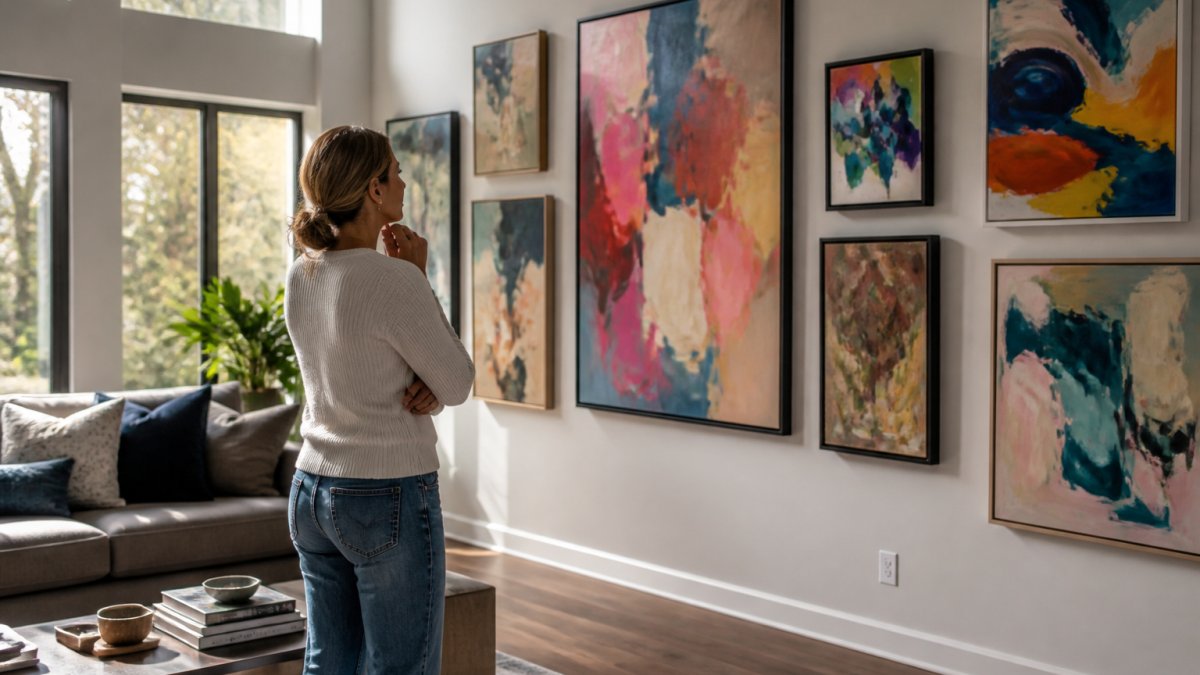
Start with your room's purpose and mood.
Consider your existing palette. Complementary art echoes colors already in your space, creating harmony; contrasting art introduces new colors and visual interest.
Think about scale relative to your wall.
Personal connection matters most. If you're drawn to a piece, if it makes you feel something, that's the signal to buy.
Direct Artist Collections: Why Buy Straight from the Creator
Buying directly from an artist changes the equation: you support the creator directly, often get better pricing, and access the artist's full vision without curation or filtering.
Buying from an artist's own collection gives you the complete story, you can ask about inspiration, process, materials, and meaning.
Pricing is often more favorable without intermediaries.
Direct relationships create accountability.
The main consideration: you're responsible for verifying authenticity and understanding the artist's policies on returns, shipping, and custom work.
Drunk Girl Art exemplifies this direct-artist model. Pieces like Martini Chaos - Colorful Cocktail Art Print capture the energy of celebration, while Red and White Wine Painting brings playful sophistication to any space.

Buying original abstract art online doesn't have to feel uncertain. When you understand how to verify authenticity, what to look for in the work itself, and where trustworthy marketplaces operate, you can shop with confidence. At Drunk Girl Art, we believe original art should feel personal and unapologetic, a reflection of who you are and how you want to live. Shop Now and discover pieces that make your space unmistakably yours.
Frequently Asked Questions
Where can I find original abstract art to buy?
Original abstract art is available through independent artist websites, online art marketplaces, and direct artist collections. Look for platforms that verify artist credentials and provide certificates of authenticity. Buying directly from creators ensures you're getting genuine original paintings rather than mass-produced reproductions. Artist-run sites often offer the widest selection of unique, hand-painted pieces in various styles and price points.
How can I tell whether abstract art is an original painting?
Verify originality by checking for a certificate of authenticity, artist statement, and provenance documentation. Original paintings show individual brushwork, texture, and variations that reproductions lack. Ask the seller about the artist's process and whether the piece is hand-painted or printed. Legitimate marketplaces provide detailed information about materials, dimensions, and creation date. Direct communication with the artist is the strongest verification method.
What should I check before buying original abstract art online?
Before purchasing, examine high-quality images from multiple angles, check the artwork's dimensions and materials, read the artist's background and credentials, review buyer protection policies, and confirm shipping and handling procedures. Verify the marketplace's return policy in case the piece doesn't match your expectations in person. Look for customer reviews and artist ratings. Understand the total cost including shipping and any applicable taxes or fees.
How do I choose an abstract painting that suits my space?
Consider your room's color palette, lighting, and existing décor style. Abstract art works best when it complements rather than clashes with your surroundings. Think about the mood you want to create, bold, energetic pieces energize a space, while softer abstracts add calm. Measure your wall space carefully and visualize scale. Many artists provide room mockups or styling suggestions. Start with pieces that resonate emotionally, as authentic connection matters more than perfect color matching.


Leave a comment